
One of the four pillars of Liberated Learning
Someone messes up.
A trust breaks, a feeling gets hurt, a rupture opens in the room.
What happens next is the whole question.
Most of what we were handed reaches for punishment — the consequence, the removal, the lecture, the cold distance that’s supposed to teach a lesson.
It teaches that mistakes mean exile, that belonging is conditional, that when you fall short you are sent away.
Restorative culture chooses the opposite.
When connection breaks, we return to it.
Punishment and repair are not two flavors of the same thing. They move in opposite directions.
Punishment severs — it puts distance between people in the name of accountability, and leaves everyone more alone.
Repair returns — it brings people back into relationship, with the rupture named and tended rather than buried.
One leaves a child certain they’re bad.
The other leaves them certain they can make a mistake and still belong.
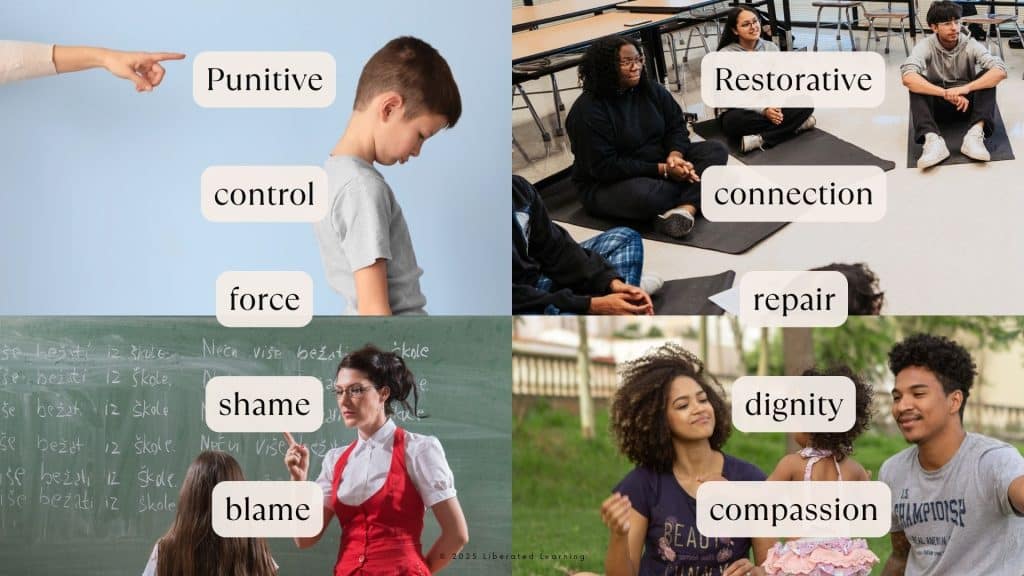
Real accountability lives in repair, not in punishment.
It asks more of us, not less — to stay in relationship through the hard part instead of escaping into consequence.
No one is born knowing how to repair in a culture that only modeled punishment.
It’s a skill, and skills are learned through practice.
We learn to pause before we react. To notice what’s happening in the body before the old script runs.
To name a rupture without shame and ask, together, how we restore what broke.
With repetition, repair stops being the exception and becomes the baseline — the thing a community reaches for first.
We circle up. We make space for voices to be heard.
We treat conflict as information about an unmet need, not as a problem to be eliminated.
We practice returning to relationship so often that it becomes what the body knows to do.
The teaching closest to this pillar:
When connection breaks, we return. That’s the whole practice.